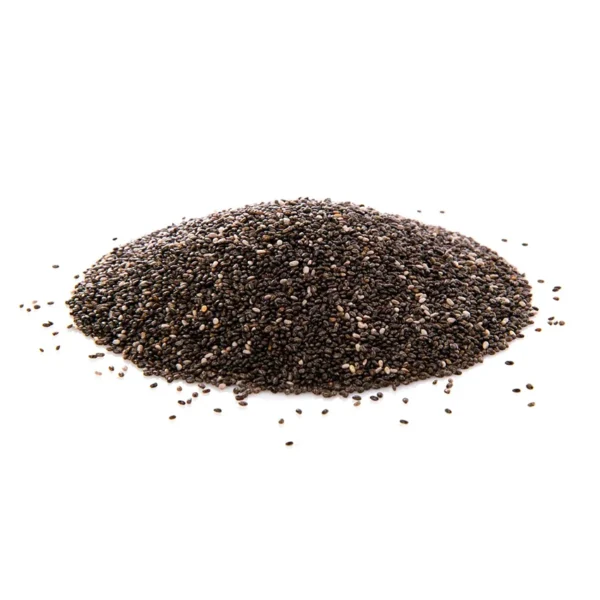
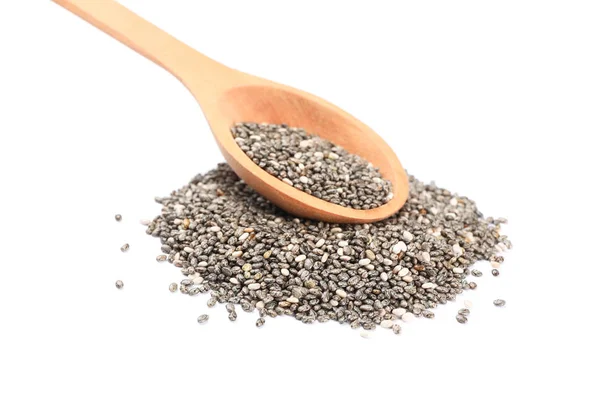
Botanical specifications
- Botanical name: Salvia hispanica
- Plant family: Lamiaceae
- Plant part used: Whole chia seeds
- Origin: Tropical America (organic)
Aztec origin · Now grown in Africa
Why our Chia seeds come from African producers
Let us be honest about Chia. Salvia hispanica is not an African plant. It is native to Mexico and Guatemala, where the Aztecs and Mayans cultivated it for over 3,000 years as a staple food. The word chia itself comes from the Nahuatl chian, meaning “oily.” The plant’s deep history is Mesoamerican, not African.
What is African is our supply chain. Chia is now successfully cultivated in several African countries from Kenya and Tanzania in the east to Nigeria, Bénin, and Burkina Faso in the west. The plant adapts well to African tropical climates, and African producers have developed thriving export-grade Chia farms over the last decade. We source from this network. The Chia you receive from us was grown in Africa, by African producers.
The Aztec super-seed of the Mexican highlands
Chia (Salvia hispanica) is a member of the mint family (Lamiaceae), native to central and southern Mexico and Guatemala. Long before Spanish colonisation, it was one of the four staple crops of pre-Columbian Mesoamerica alongside maize, beans, and amaranth. Aztec warriors and runners carried Chia seeds as a high-energy travel ration, mixed with water and a little salt or lime juice. A small handful was said to sustain a person for a full day of travel.
The seed nearly disappeared after the Spanish conquest, when colonial authorities suppressed indigenous foods in favour of European staples. It survived in remote Mexican villages and on a small scale in Guatemala, then re-emerged in the late 20th century as a global “superfood” on the back of modern nutritional research. Today the largest commercial Chia growers are in Mexico, Bolivia, Argentina, Paraguay, Australia, and a growing share of African countries.
Why Chia grows well in Africa and why we source there
Chia is a relatively undemanding crop. It grows on marginal soils, tolerates drought once established, and produces high-value seeds within four to five months. These traits have made it attractive to African smallholder farmers and agroforestry projects looking for cash crops that suit local conditions without requiring heavy irrigation or chemical inputs. Several African universities and agricultural extension programs have actively promoted Chia cultivation since the early 2010s.
By sourcing our Chia in Africa rather than importing from South America, we keep more of the value chain on the continent we live on. Our African Chia is grown by smallholder farmers using low-input methods no industrial fertilisers, no chemical pesticides, harvested by hand. The seeds are sun-dried, cleaned, and packaged with the same care we apply to the rest of our catalogue.
This is honest sourcing: we do not pretend Chia is an ancient African crop, because it isn’t. But the Chia you buy from us was grown in Africa, by African farmers, packaged in Bénin, and shipped from Cotonou. That is a genuine supply chain.
The nutritional reason Chia became famous
Modern peer-reviewed research has confirmed what the Aztecs apparently knew through trial and error: Chia is one of the most nutritionally dense seeds in the plant kingdom. It is exceptionally rich in alpha-linolenic acid (ALA omega-3), with roughly 60% of its fat content as omega-3 fatty acids a higher proportion than even flax. It contains complete plant protein (about 16–20% by weight), all nine essential amino acids, soluble and insoluble fibre, calcium, magnesium, iron, and a measurable level of antioxidant polyphenols.
Chia seeds also have an unusual physical property: when soaked in water, they form a gel coating as the soluble fibre on the seed surface absorbs liquid. This gel makes Chia useful as a thickening agent in puddings, drinks, and as an egg replacement in baking. It also slows digestion, which is why Chia is associated with sustained energy release rather than blood sugar spikes.
What our African-grown Chia gives you
- Authentic Salvia hispanica grown in Africa by smallholder farmers using low-input methods not industrial South American export crops.
- Honest sourcing. We do not invent an African origin for an Aztec plant. The plant came from Mexico; our supply chain is in Africa.
- Sun-dried and minimally processed to preserve the heat-sensitive omega-3 fatty acids.
- Densest plant source of ALA omega-3, complete plant protein, fibre, calcium, magnesium, iron, and antioxidants.
- Versatile. Soak for puddings and gels, sprinkle on salads, blend into smoothies, use as an egg replacement in baking, mix into bread and granola.
- Phytosanitary certificate issued for every export shipment, as required by international plant-product regulation.
- A purchase that gives back. Each order contributes to community development work in our partner regions across West Africa.
Reviews
There are no reviews yet.